
Access Crawford County Divorce Records
Crawford County divorce records are filed and maintained at the Circuit Court Family Division in Grayling. This page covers how to search for cases online through MiCOURT, how to contact the county clerk for copies, how to request vital record certificates from MDHHS, and what Michigan law says about residency, waiting periods, and property division in Crawford County divorce cases.
Crawford County Overview
Crawford County Circuit Court - Family Division
The 46th Judicial Circuit Court in Grayling handles all divorce filings for Crawford County residents. The Family Division oversees divorce, custody and parenting time, child support, paternity, and personal protection orders. Crawford County is a small, rural county in northern Michigan's Lower Peninsula. The courthouse and clerk's office are on West Michigan Avenue in Grayling. All divorce case files are stored there, and the clerk handles all records requests.
Because Crawford County is small, the clerk's office handles a lower volume of cases compared to more urban counties. This can sometimes make records easier to locate and retrieve. Staff at the clerk's office can search for a case by party names or case number. If you call ahead and have the basic information ready, you may be able to get what you need quickly. Always confirm office hours and current fees before making the trip if you are coming from out of the area.
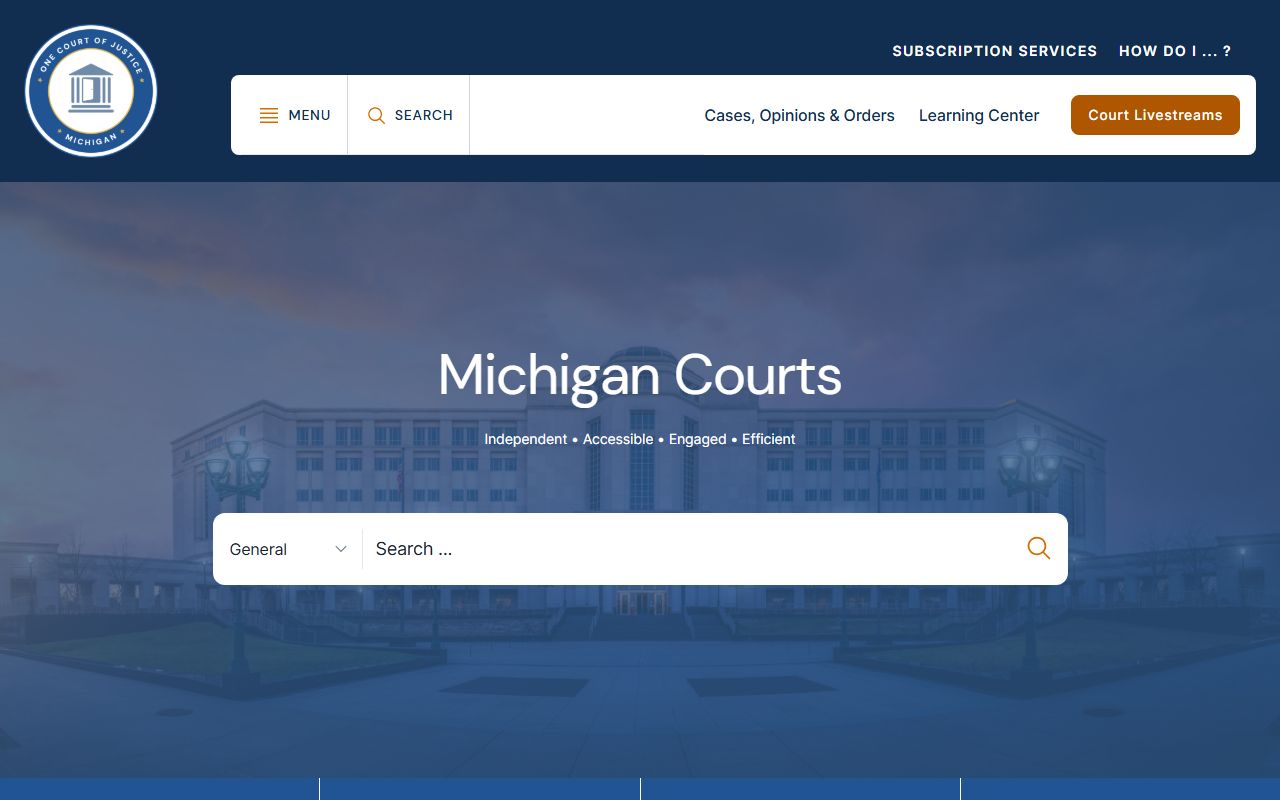
The Michigan Courts website at courts.michigan.gov has a court locator tool and SCAO-approved divorce forms that apply to Crawford County cases. You can use the court locator to verify the specific Circuit Court handling Crawford County divorce filings.
| Court | 46th Judicial Circuit Court, Family Division |
|---|---|
| Address | 200 W. Michigan Ave. Grayling, MI 49738 |
| Phone | 989-348-2841 |
| Hours | Monday through Friday, 8:00 AM to 4:30 PM |
Search Crawford County Divorce Records Online
Crawford County divorce cases are searchable through the statewide MiCOURT case search system. MiCOURT covers the 46th Judicial Circuit and is free to use. Search by a party's name or by case number. Results show the case type code (DM for divorces with minor children, DO for divorces without), the filing date, current status, and a register of actions that lists key events in the case. You cannot download documents through MiCOURT, but you can verify that a case exists and get the case number you need to contact the clerk for copies.
If the case you are searching for does not appear in MiCOURT, it may have been filed before the 46th Circuit began using electronic case management. Older records are stored on paper at the clerk's office. Call 989-348-2841 and ask staff to search the manual index. They will need both parties' names and an approximate year. Response times vary, so it is a good idea to follow up by mail if you do not hear back within a few days.
MiCOURT shows case information, not document images. Copies of judgments, petitions, or other filings from a Crawford County divorce case must be requested directly from the county clerk.
How to Get Crawford County Divorce Records
In-person requests at the Crawford County Courthouse are the quickest option. Visit the clerk's office at 200 W. Michigan Ave. in Grayling during business hours. Bring a photo ID. Tell the clerk the names of both parties or give the case number. Staff will retrieve the file and make copies while you wait. Plain copies are $1 to $2 per page. Certified copies carry an added fee. Ask the clerk about the certification fee for the specific document you need before assuming the cost.
To request by mail, write to the Crawford County Clerk at 200 W. Michigan Ave., Grayling, MI 49738. Include both parties' full names, the approximate year of the divorce, and the case number if you have it. Attach payment by check or money order for the estimated copy fees and a self-addressed stamped envelope. The clerk will reach out if the payment does not cover the full cost. Mail requests usually take one to two weeks to process and return.
For a certified divorce certificate as a vital record, contact MDHHS rather than the county clerk. The Michigan Department of Health and Human Services maintains statewide divorce certificates. The cost is $34 for the first certified copy and $16 for each additional copy ordered together. Submit your request at michigan.gov/mdhhs/doing-business/vitalrecords. A divorce certificate from MDHHS is a brief summary of the divorce, while the judgment of divorce from the clerk is the full court document. Each serves different purposes, so confirm which one you actually need before requesting.
Michigan law under MCR 8.119(K) requires courts to keep case records for a minimum of 40 years. Final judgments are kept permanently. Crawford County divorce records from past decades should be accessible through the clerk's office.
Michigan Divorce Law and Crawford County Cases
Every divorce filed in Crawford County is governed by Michigan state law. Michigan uses a no-fault standard. Under MCL 552.6, the grounds for divorce are that there has been a breakdown of the marriage relationship and no reasonable likelihood exists that it can be preserved. The filing spouse does not need to show that the other party did anything wrong. The 46th Circuit Court judge evaluates the case under this standard and grants the divorce if the requirements are met.
Residency must be established before you file. Under MCL 552.9, one spouse must have lived in Michigan for 180 days and in Crawford County for at least 10 days prior to filing. Crawford County's small size means some residents live just across a county line. If you recently moved to Crawford County, make sure the 10-day county requirement is satisfied before filing at the courthouse in Grayling.
Waiting periods apply. Cases without minor children require a minimum 60-day wait after filing before a final judgment can be entered. Cases with minor children require 180 days. A judge can reduce the waiting period for good cause in unusual circumstances, but this is not common. The waiting period starts when the complaint is filed and accepted by the clerk, not when the other party is served.
Under MCL 552.19, marital property is divided equitably. The court looks at what is fair, not what is equal. The length of the marriage, each person's contributions, and their financial situations all factor into the judge's decision. When children are involved, the Friend of the Court in Crawford County reviews custody and support matters and makes recommendations to the judge. The full text of Michigan's divorce statutes is available at legislature.mi.gov.
Legal Help for Crawford County Residents
Free resources exist for Crawford County residents handling a divorce without an attorney. Michigan Legal Help at michiganlegalhelp.org provides step-by-step guides and form interviews for Michigan divorce cases. The site explains filing procedures, what forms to use, and how the process works in smaller northern Michigan courts like the 46th Circuit. It is built for self-represented parties and is free to use.
All SCAO-approved forms for Michigan divorce cases are available free at courts.michigan.gov. These are accepted by the 46th Circuit Court in Grayling. The MiFILE system at mifile.courts.michigan.gov supports electronic filing for Michigan courts including Crawford County. If you need an attorney in the Grayling area, the State Bar of Michigan can refer you to a family law practitioner who handles northern Michigan cases.
Cities in Crawford County
Crawford County does not have any cities above the qualifying population threshold. Grayling serves as the county seat and is where the 46th Circuit Court is located. All divorce cases for Crawford County residents are handled at the courthouse in Grayling.
Nearby Counties
These counties are close to Crawford County. If you are uncertain which county has jurisdiction over a case, look at where the filing party lives. Jurisdiction is based on residency, not proximity to a city.