
Find Michigan Divorce Records Online
Michigan divorce records come in two forms: divorce certificates held by the Michigan Department of Health and Human Services (MDHHS) and full case files kept at the Circuit Court in each county. You can search Michigan divorce records online through the MiCOURT system, request certified copies from MDHHS, or visit the Circuit Court Clerk in the county where the case was filed. This guide covers every method available to find and access Michigan divorce records, including fees, residency rules, and state laws that govern access.
Michigan Divorce Records Overview
Where to Find Michigan Divorce Records
Michigan keeps divorce records in two separate places, and which one you need depends on what type of document you want. The Michigan Department of Health and Human Services (MDHHS) Vital Records office maintains divorce certificates from 1897 to the present. These are brief summary documents that list names, date of divorce, county of filing, and case number. They are useful for legal name changes and insurance purposes. The first certified copy costs $34 and each additional copy is $16. Note that MDHHS does not issue certificates until at least 90 days after the divorce date, and some records before 1924 may not be on file.
For the full case file, the Circuit Court in each county is where you go. Michigan has 83 counties and each one has a Circuit Court Family Division that handles all divorce filings. This is the court that holds the complaint, financial statements, separation agreement, and the judgment of divorce signed by the judge. Court clerks can make copies of any non-sealed document in the file. Copy fees at county courts typically run $1 to $2 per page, with certification adding another $10 to $15 per document.
Historical divorce records from before 1897 may exist at county circuit courts or at the Michigan State Archives at 702 Kalamazoo Street, Lansing. The Archives phone is 517-373-1408. The Family History Library and Ancestry.com both have Michigan divorce records from 1897 to 1952 for genealogy research.
The MDHHS Vital Records office is located at the Capitol View Building, 3rd Floor, 201 Townsend Street, Lansing. You can reach them by phone at (517) 335-8656. In-person service is available but you must arrive before 3:00 PM for same-day processing.
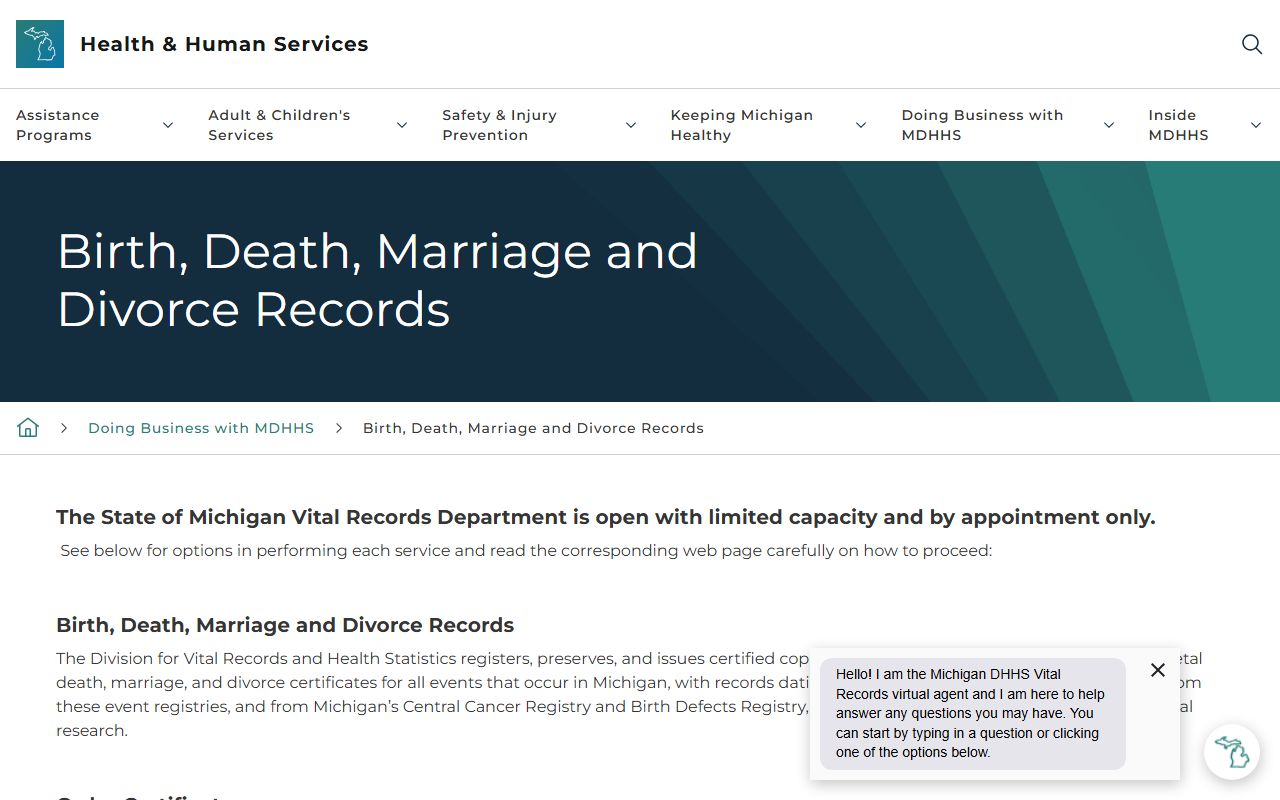
The MDHHS website at michigan.gov/mdhhs lets you download application forms and learn about online ordering options. Standard processing takes 7 to 15 business days. Rush service with Federal Express delivery is available for an extra $12, and takes 3 to 5 business days.
Note: MDHHS handles divorce certificates only. For the actual divorce decree or full case file, contact the Circuit Court Clerk in the county where the divorce was filed.
How to Search Michigan Divorce Records Online
The main online tool for Michigan divorce records is MiCOURT, the statewide court case management system. You can access it at micourt.courts.michigan.gov. This system is free to use. It covers Circuit Courts across the state and lets you search by party name, case number, attorney bar number, or date range. Results show case numbers, filing dates, case types, party names, and the register of actions. Not every county participates fully, and actual documents are not available for download. But basic case data, including whether a divorce was filed and the current status, is usually available.
Michigan divorce case numbers include a code that tells you the type. Cases marked DM involve minor children. Cases marked DO do not. These codes appear in the MiCOURT search results and in official documents from the court.
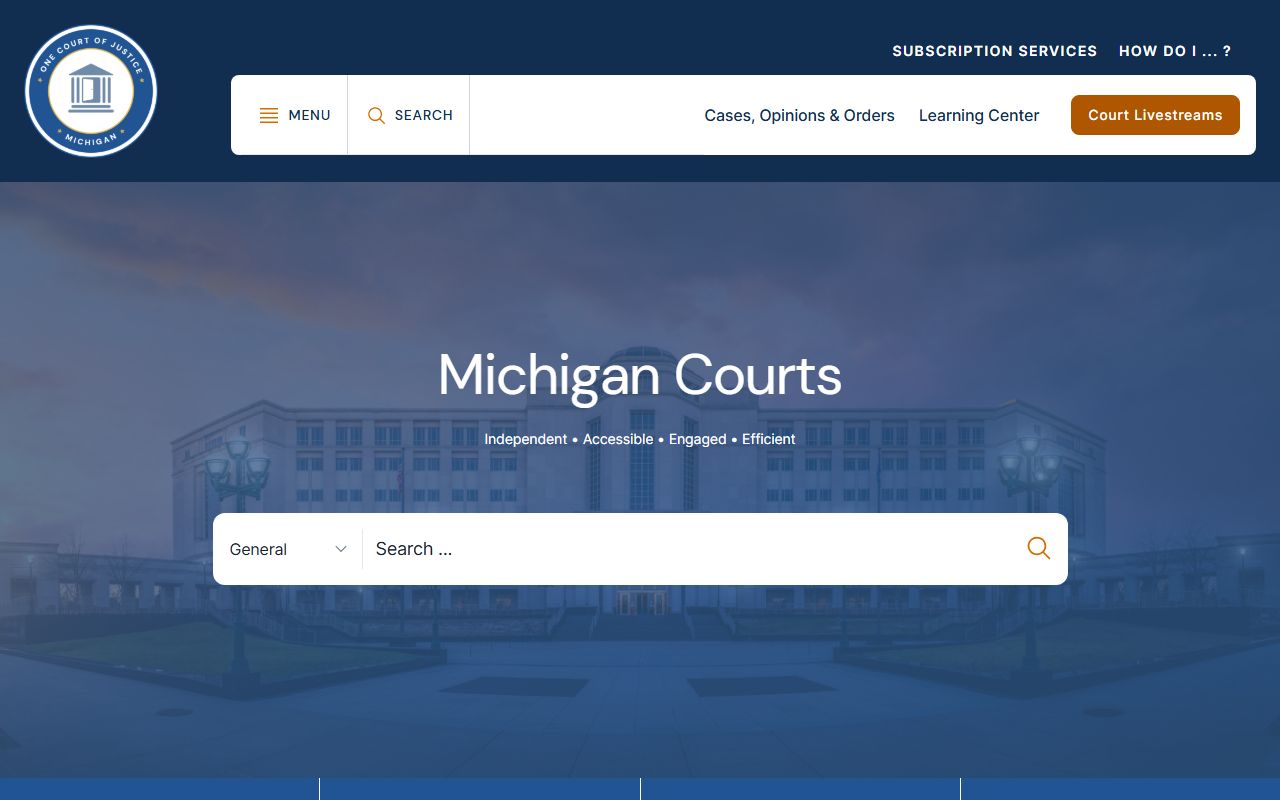
The Michigan Courts official website at courts.michigan.gov has a court locator tool, fee schedules, SCAO-approved forms, and links to each county's local court resources. It is the best starting point if you are not sure which court handled a case. The site also has a full list of Circuit Courts by county with contact information.
Some counties have their own separate online systems. Oakland County uses Court Explorer. Kent County uses AccessKent, which even lets you order certified divorce judgments online for $15. Ingham County offers free access at courts.ingham.org for cases filed after October 2009. Check the specific county page for local search tools.
eFiling for divorce cases in Michigan runs through MiFILE at mifile.courts.michigan.gov. Most Circuit Court filings must go through this system. It handles new divorce cases, motions, and supporting documents. This is where attorneys and self-represented litigants file electronically.
Types of Michigan Divorce Records
There are two main record types in Michigan. The divorce certificate is the summary document from MDHHS. It shows names, date granted, county, and case number. The judgment of divorce is the full court order from the Circuit Court. It covers property division, child custody, parenting time, support amounts, and any name changes. Most people need the judgment of divorce for legal or financial matters. The certificate works for proving you are no longer married but does not show the detailed terms.
Beyond those two, the full case file at the Circuit Court may include the complaint for divorce, the summons, verified statements, financial disclosures, UCCJEA affidavits (for cases with children), child support worksheets, and motions filed during the case. All of these are part of the public record unless a judge has sealed them. You can request copies of any document in an open case file. Sealed records are not available without a court order.
Michigan divorce records going back to 1897 exist at the state level. Records before 1897 can sometimes be found in county circuit court archives or Michigan Supreme Court records from the earliest years of the state.
The Record of Divorce or Annulment form captures key data for state reporting under MCL 333.2864. Circuit court clerks file monthly reports with the state registrar. This is how divorce records enter the MDHHS vital records system. The form includes plaintiff and defendant names and birthdates, marriage date, number of minor children, and the judgment recorded date.
Note: Social Security numbers, financial account numbers, and driver's license numbers are redacted from public documents under MCR 8.119(F) before release.
Michigan Divorce Laws and Statutes
Michigan became a no-fault divorce state on January 1, 1972. Under MCL 552.6, the grounds for divorce are "a breakdown of the marriage relationship to the extent that the objects of matrimony have been destroyed and there remains no reasonable likelihood that the marriage can be preserved." No proof of fault or wrongdoing is required. The plaintiff does not need to explain further than the statutory language. Fault can still play a role in property division and support decisions, but it is not required to file.
Residency rules come from MCL 552.9. One spouse must have lived in Michigan for at least 180 days before filing. You also need to have lived in the county where you file for at least 10 days. These are jurisdictional requirements the court cannot waive. Cases involving domestic violence may have different venue rules.
Waiting periods apply after you file. Without minor children, the case cannot be finalized for at least 60 days. With minor children, the waiting period is 180 days. A judge can waive part of this for good cause in some cases. These delays are built into Michigan law and affect how long the process takes from filing to final judgment.
Property division in Michigan follows equitable distribution under MCL 552.19. The court divides property as it deems "just and reasonable." This does not mean 50/50. The judge looks at the length of the marriage, each spouse's income and earning capacity, contributions to the marital estate, and other factors. Spousal support is governed by MCL 552.13. The court can order support, which typically ends on remarriage unless the agreement states otherwise.
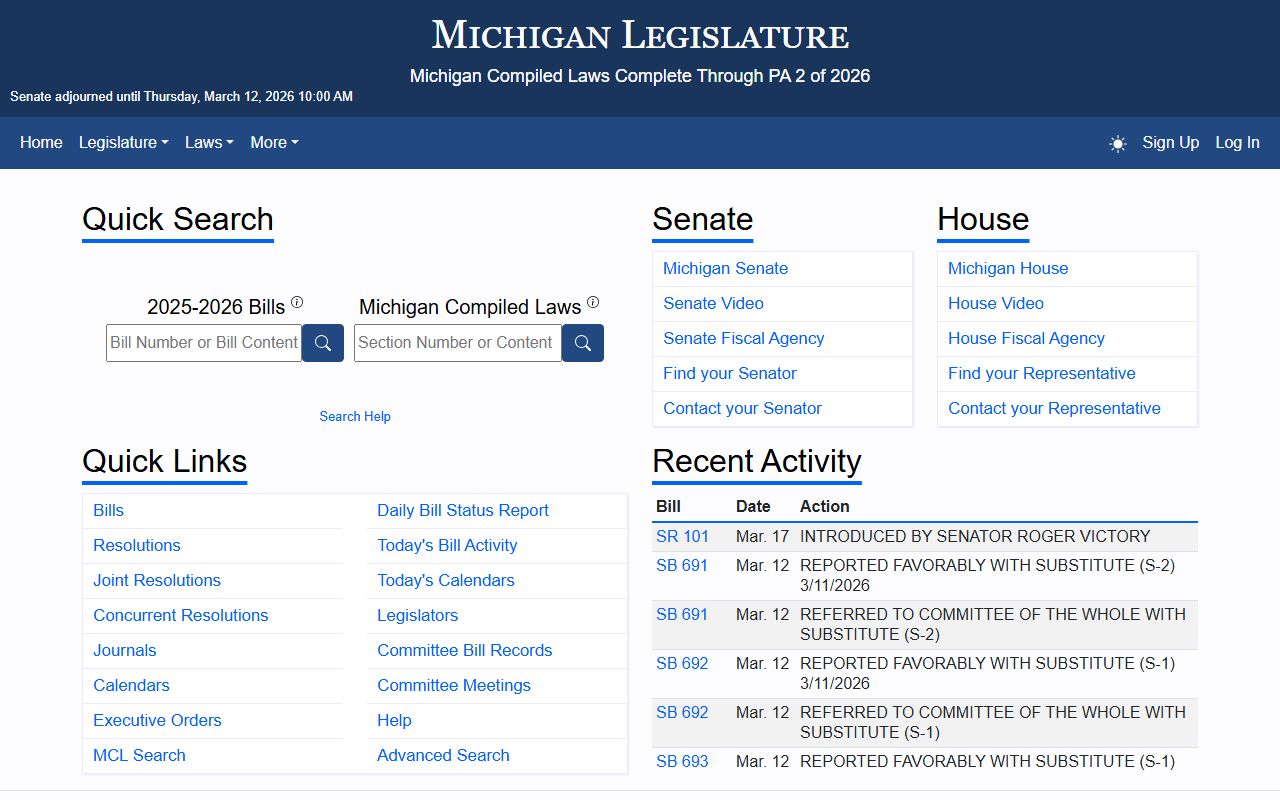
The Family Division of Circuit Court has exclusive jurisdiction over divorce under MCL 600.1021, effective January 1, 1998. All divorce cases in Michigan go through this division. The Michigan Legislature website at legislature.mi.gov is the official source for all Michigan statutes and court rules.
Access to court records is governed by Michigan Court Rule 8.119. Case records are public unless restricted by statute, court rule, or court order. Financial statements, Social Security numbers, children's identifying info, and records sealed by a judge have restricted access. A party can request sealing under MCR 8.119(I) by showing good cause, such as a safety concern or serious privacy interest.
Michigan Divorce Filing Fees
Filing fees vary by county in Michigan because each Circuit Court sets its own schedule. Wayne County, which includes Detroit, charges $421 to file a divorce. Kent County charges different fees. Many counties fall in the $150 to $250 range for an initial filing. You need to check with the specific county court for current amounts. In addition to the filing fee, there may be a summons fee, motion fees, and fees for getting copies.
For divorce certificates from MDHHS, the fee is $34 for the first certified copy and $16 for each additional copy of the same record. Rush service adds $12. Online orders may carry a small convenience fee. Mail requests typically take 7 to 15 business days. For pre-1920 records, allow 3 weeks to 3 months due to the age and condition of those files.
For certified copies of divorce judgments from county courts, most charge $10 to $15 per certified document plus $1 to $2 per page for copying. Some counties charge a search fee of $10 or more if staff must locate the record by date rather than case number. Lapeer County charges $15 for the first certified copy and $5 for each additional, plus $12 for the first year searched and $1 per additional year.
Note: Fee waivers are available for people with low income. Ask the Circuit Court Clerk for an application to waive fees based on financial hardship.
How to Get Copies of Michigan Divorce Records
To get a divorce certificate from MDHHS, you can visit in person, mail a request, or order online. In person, go to the Capitol View Building, 3rd Floor, 201 Townsend Street, Lansing, before 3:00 PM. By mail, send a completed application with payment to: Vital Records Request, P.O. Box 30721, Lansing, MI 48909. Call (517) 335-8656 for recorded information or (517) 335-8666 to speak with someone. You must provide both parties' full names, the approximate date of divorce, and the county where it was granted. A copy of your government-issued photo ID is required for certified copies.
To get a divorce decree from the county court, contact the Circuit Court Clerk in the county where the case was filed. Wayne County records go through the Wayne County Clerk Records Division at Coleman A. Young Municipal Center, Room LL-61, 2 Woodward Ave, Detroit, phone 313-224-5530. Ingham County has free online access at courts.ingham.org for cases filed since October 2009. Saginaw County can be reached at 989-790-5251. Every county has its own process and you can find local details on the county pages below.
Mail requests to county courts take 1 to 3 weeks. In-person requests are often handled the same day if the file is available. Include names of both parties, the approximate year of filing, and a case number if you have one. Include payment and a self-addressed stamped envelope for mail requests.
If you do not know the county where the divorce was filed, start with MiCOURT. Search by name and date range. The results will show the county and case number, which you then use to contact the right clerk's office directly.
Legal Help and Self-Help Resources
Michigan Legal Help at michiganlegalhelp.org is one of the most useful free resources for people who need divorce records or want to file for divorce on their own. The site has guided interviews that walk you through the process step by step and generate completed court forms based on your answers. It covers the full divorce process, Friend of the Court services, and how to modify existing orders. All the information is written in plain language for people without legal training.
The Michigan State Archives at 702 Kalamazoo Street, Lansing, MI 48909-8240 holds historical divorce records, including some from before 1897. Hours are Monday through Friday, 9:00 AM to 4:00 PM. Phone: 517-373-1408. Email: archives@michigan.gov. These records can be useful for genealogical research and for cases involving very old documents that county courts may have transferred.
For legal representation, the State Bar of Michigan at michbar.org has a lawyer referral service. If you need help with a records request, understanding a divorce decree, or any family law matter, a referral can connect you with a qualified attorney.
Note: Michigan Legal Help offers free interactive tools to help you find the right forms and understand what documents you need based on your specific situation.
Are Michigan Divorce Records Public?
Yes, most Michigan divorce records are public. Under Michigan Court Rule 8.119(H), case records are open to anyone who requests them during business hours. You do not need to be a party to the case. You do not need to give a reason. Basic case data and most filed documents are available to the public at the Circuit Court Clerk's office.
Some items have restricted access. Financial statements filed in a divorce case are not always open to the public. Social Security numbers, financial account numbers, and children's identifying information must be redacted before public release under MCR 8.119(F). Adoption, juvenile, and mental health records are excluded from public access entirely. Records sealed by a court order are not viewable without going back to the judge who sealed them.
Under MCL 333.2882, certified divorce certificates from MDHHS have more limited access than court records. Only parties to the divorce, their legal representatives, and people with a direct and tangible interest can get certified copies. Heirs may obtain records with proper documentation showing their relationship to the parties.
Divorce case files are retained for a minimum of 40 years from the final order under MCR 8.119(K). Judgments have permanent retention. So even old cases are still on file at the county court, though very old files may need to be ordered from county archives rather than pulled immediately.
Browse Michigan Divorce Records by County
Each of Michigan's 83 counties has its own Circuit Court Family Division that keeps divorce records. Pick a county below to find local clerk contact info, fees, online search tools, and other resources for divorce records in that area.
Divorce Records in Major Michigan Cities
Residents of Michigan's largest cities file for divorce at their county's Circuit Court Family Division. Pick a city below to learn about divorce records in that area, including which county handles the case and how to reach the right clerk's office.