
Access Charlevoix County Divorce Records
Charlevoix County divorce records are held at the Circuit Court clerk's office at 203 Antrim Street in Charlevoix. All divorce cases for the county are filed here, and the clerk maintains the full file for each case. You can search Charlevoix County cases online for free using the statewide MiCOURT system, then get copies of documents by visiting the clerk in person or making a mail request. This guide covers how to find and request Charlevoix County divorce records and explains Michigan divorce law as it applies to cases in this county.
Charlevoix County Overview
Charlevoix County Circuit Court - Family Division
The Charlevoix County Circuit Court handles all divorce cases filed in the county. Its Family Division covers divorce, child custody, parenting time, support orders, and personal protection orders. All Charlevoix County divorce records are kept at the courthouse at 203 Antrim Street. The court serves both the mainland part of the county and Beaver Island, which is part of Charlevoix County. If either spouse lives in Charlevoix County when the case is filed, this court has jurisdiction.
The clerk's office at 203 Antrim Street processes all record requests. Staff search by name or case number. Bring a valid photo ID when visiting. Have both parties' names and the approximate year of the divorce ready. A case number from MiCOURT helps speed up the search. Older records that are not yet digitized may take a short time to retrieve from archive storage.
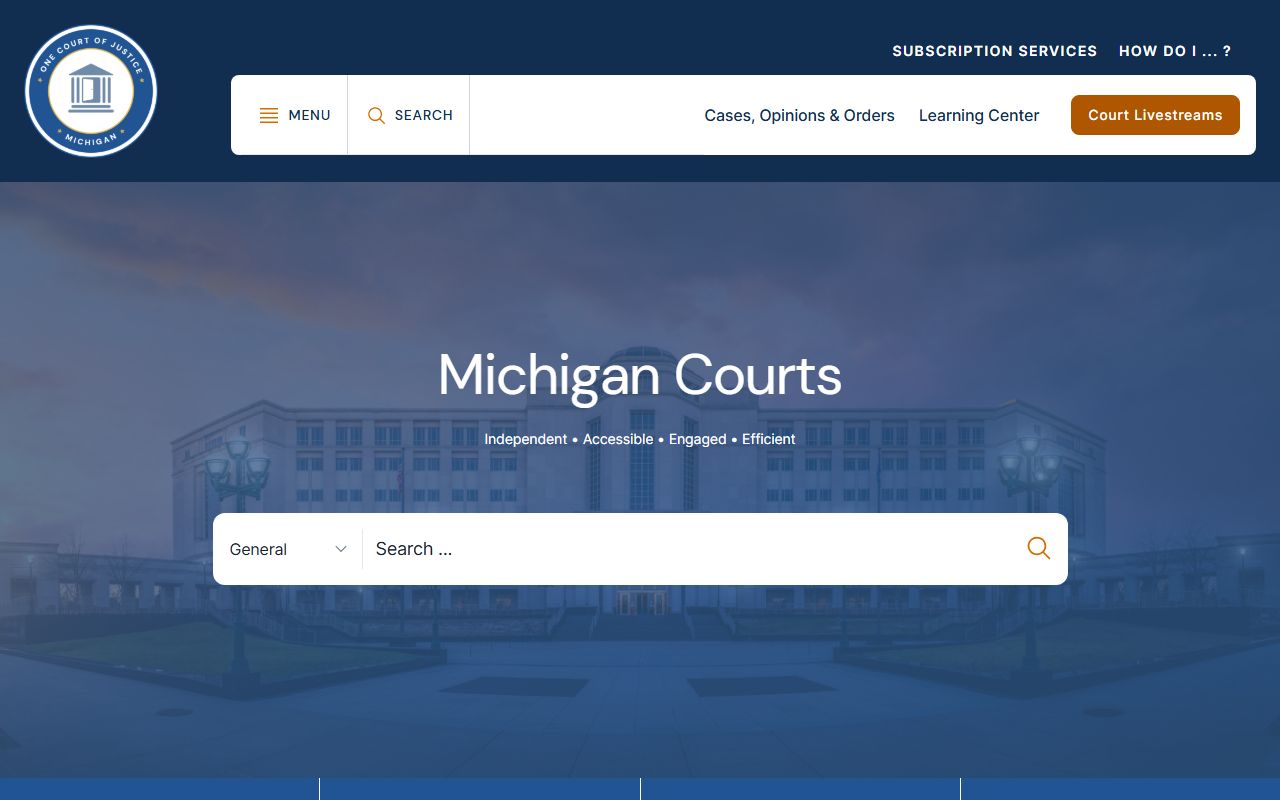
The Michigan Courts official website at courts.michigan.gov provides a court locator, SCAO-approved divorce forms, and links to the Charlevoix County Circuit Court directly. From there you can find the specific contact info, hours, and online resources for Charlevoix County divorce records.
| Court | Charlevoix County Circuit Court, Family Division |
|---|---|
| Address | 203 Antrim St. Charlevoix, MI 49720 |
| Phone | 231-547-7200 |
| County Seat | Charlevoix |
How to Search Charlevoix County Divorce Records Online
The free statewide MiCOURT case search at micourt.courts.michigan.gov is the best tool for searching Charlevoix County divorce cases online. No account is needed. Search by either party's name or by case number. Charlevoix County divorce cases appear under case type DM (divorce with minor children) or DO (divorce without children). Both types show up in the search results.
MiCOURT results include the register of actions for each case. This lists every filing, every hearing, the assigned judge, and the case status. It confirms whether a final judgment has been entered. Documents cannot be downloaded through MiCOURT, but you get all the identifying information you need to request copies from the Charlevoix County clerk's office. Note the case number before you contact the clerk.
The MiFILE electronic filing system at mifile.courts.michigan.gov allows attorneys and self-represented parties to submit documents to the Charlevoix County Circuit Court without traveling to Charlevoix. This is useful for parties who live outside the county or on Beaver Island. Visit MiFILE for instructions on what document types it accepts for Charlevoix County filings.
Note: MiCOURT shows case information only, not actual documents. To get copies of Charlevoix County divorce records, contact the clerk at 231-547-7200 or visit 203 Antrim St., Charlevoix.
How to Request Charlevoix County Divorce Records
Visiting the clerk's office in person is the most direct method. Go to 203 Antrim Street in Charlevoix during regular business hours. Bring a valid photo ID. Provide both parties' names and the approximate year of the divorce. A case number from MiCOURT speeds the process. Staff will pull the file and make copies. You pay when the copies are ready.
For mail requests, write to the Charlevoix County Clerk, 203 Antrim St., Charlevoix, MI 49720. Include both parties' full legal names, the year of the divorce, the case number if you have it, and a specific description of the documents you need. Attach a check or money order for the estimated fee and a self-addressed stamped envelope so the clerk can return your copies. Call 231-547-7200 before mailing to confirm the current fee schedule and whether any specific form is required for the request.
Michigan circuit court copy fees are typically $1 to $2 per page. Certified copies carry an added fee of $10 to $15 per document. Charlevoix County follows these standard Michigan ranges. If you need certified copies for remarriage, a name change, or another legal use, ask specifically for certified copies in your request. A search fee may apply if staff must locate records without a case number. Confirm all fees before sending payment.
MDHHS maintains statewide divorce certificates for all Michigan counties from 1897 onward. The first certified copy costs $34; each additional copy is $16 when ordered together. Order through michigan.gov/mdhhs/doing-business/vitalrecords. These records document that a divorce occurred but do not include the full court file or judgment details. For those documents, contact the Charlevoix County clerk's office.
Michigan Divorce Law and Charlevoix County Cases
All Charlevoix County divorce cases are governed by Michigan state law. Michigan adopted no-fault divorce in 1972. Under MCL 552.6, the legal basis for divorce is a breakdown of the marriage relationship with no reasonable likelihood of preservation. No fault needs to be proven. Either spouse may file.
Residency requirements under MCL 552.9 must be satisfied before the Charlevoix County Circuit Court can take jurisdiction. One spouse must have lived in Michigan for at least 180 days before filing. One spouse must also have lived in Charlevoix County for at least 10 days before the case is filed. These rules apply to every divorce case in every Michigan county.
Waiting periods apply before a divorce can be finalized in Michigan. Without minor children, at least 60 days must pass from the filing date. With minor children, the minimum wait is 180 days. Judges may shorten these periods for documented good cause. Most Charlevoix County cases take longer than the minimum because of the time needed to resolve property, custody, and support issues.
Property is divided under MCL 552.19, which requires equitable distribution. The court divides marital assets in a way that is fair and reasonable based on the facts of the case. Equal shares are possible but not required. The judge considers the length of the marriage, what each spouse contributed, and the financial situation each person will face after the divorce. Spousal support may be awarded when one spouse has fewer resources or lower earning capacity.
All Michigan divorce statutes are available at legislature.mi.gov. Every provision of MCL 552 applies to Charlevoix County cases the same as anywhere else in the state.
Getting Help with Charlevoix County Divorce Records
Michigan Legal Help at michiganlegalhelp.org is free for anyone dealing with divorce in Michigan. The site guides you through the process step by step, generates forms for the Charlevoix County Circuit Court, and explains the law in plain language. No legal background is needed to use it.
All SCAO-approved divorce forms are free to download at the Michigan Courts website at courts.michigan.gov. These are the forms required in Michigan circuit courts, including Charlevoix County. Using the correct official form prevents delays and rejections. The courts site also has a locator with current contact information for Charlevoix County.
The State Bar of Michigan at michbar.org has a lawyer referral service that can connect you with family law attorneys who handle cases in northwest Michigan and Charlevoix County. Legal representation is worth considering for contested property, custody, or support cases.
MDHHS divorce certificates are available at michigan.gov/mdhhs. These are ordered separately from circuit court records and cover all Michigan counties going back over a century.
Cities in Charlevoix County
Charlevoix County has no cities that meet the population threshold for individual city pages. All divorce cases from communities in the county, including Charlevoix, Boyne City, and East Jordan, are filed at the Circuit Court in Charlevoix.
Nearby Counties
These counties border or are near Charlevoix County in northwest Michigan. Jurisdiction for a divorce case follows where the filing party lived when the case was filed.